NSW + QLD, one page
Do you need council approval to remove a tree?
The rules change at the border, and most operators only know one side. Here's both, in plain language, plus a free five-question tool that gives you a likely answer in under a minute.
The border problem
A tree that's fine on one side can need a full application on the other.
Properties on the NSW side of the Tweed River sit under Tweed Shire Council. Properties from Coolangatta north are under City of Gold Coast. Different state laws, different size thresholds, different exemptions, different fees, different penalties. Most tree operators treat this as one market. It isn't, and getting it wrong can mean a fine that runs into the tens of thousands.
Before any chainsaw work, we tell you whether your job likely needs approval, which council it falls under, and what they'll want to see. We don't lodge the application for you (that stays the property owner's responsibility), but we make the scope match what council expects, so it goes through as cleanly as possible.
Tree rules change at the border.
Local natives over 5m, very large trees, koala feed trees and threatened species are protected.
Trees over 4m tall, or about 40cm around the trunk, need assessment. Cocos palm removal is exempt.
Before any chainsaw work, we tell you which side's rules apply and point you to the right form.
Free tool
Check your tree in under a minute
Five questions, a likely answer, and we confirm it for free on a site visit. Your result can be emailed to you with a booking link.
- Routes you to the right council automatically
- Flags the cocos-palm exemption if it applies
- Tells you if you'll need an arborist report
Free tool
Do I need council approval?
Five quick questions for a likely answer. We confirm it for free on a site visit.
Quick check
Does this look right?
Tap any line to change it, then get your likely answer.
Your likely answer
Side by side
What each council protects
Tweed Shire Council
Protected "prescribed vegetation" includes:
- Local native trees 5m or taller
- Very large trees (0.8m trunk diameter at 1.4m)
- Primary koala feed trees (swamp mahogany, forest red gum, tallowwood, grey gum)
- Threatened species and heritage-listed trees
Good to know: applying to Tweed Shire is free, and council won't refuse a genuinely dead or dangerous tree backed by a report.
City of Gold Coast
Vegetation is "assessable" if it's:
- Over 4 metres tall, or
- 40cm or more around the trunk at 1.4m (about 12.7cm thick)
- Mapped remnant or significant vegetation
But there are self-assessable exemptions: near boundaries and buildings, pool fencing, bushfire zones, pest species, and Council-authorised dangerous-tree determinations.
Last council rules check: 24 May 2026. Rules change and exemptions have conditions, so always confirm the current requirements directly: Tweed Shire Council · City of Gold Coast.
Gold Coast properties
Pest species & Cocos palm removal
Some pest or environmental weed species can have different removal requirements from protected vegetation.
Where applicable, our AQF Level 3 arborist can identify the species on site and check the relevant Gold Coast requirements before work begins.
Cocos palms and other pest species
Cocos palms are a common environmental weed on the Gold Coast and may be subject to specific pest-species management provisions.
If you believe you have a Cocos palm or another regulated pest species, we can assess it on site and advise you on the appropriate removal pathway.
No guessing, no unnecessary applications. We check the property and the applicable requirements first.
What happens on site
- 1 Species identification Our qualified arborist identifies the tree or palm and assesses the site.
- 2 Requirements checked We confirm whether the vegetation is subject to protection or whether a pest-species pathway may apply.
- 3 Removal carried out correctly Where removal is permitted, we can carry out the work safely and provide the relevant documentation where required.
- 4 Cleaned up properly Everything is chipped, removed and cleaned up before we leave.
Important
Vegetation rules can differ between the Gold Coast and NSW, and even between individual properties depending on planning controls and other site-specific requirements.
That's why we check the property before starting work rather than assuming a tree or palm is exempt.
If you've got a Cocos palm or another suspected pest species, give us a call and we'll check the situation before you commit to anything.
Call Casey 0474 250 832Gold Coast only
Cocos palms may not need an application
On the Gold Coast, cocos palm (along with umbrella tree, cadaghi, slash pine and coral tree) is listed as a pest species under self-assessable outcome SO5. Where that pathway applies, it can be removed without a council application, provided an AQF Level 3 arborist identifies and documents it.
Casey holds AQF Level 3, so where the property and the species qualify, we can do the identification, document it and remove the palm in the one visit. We check the property and the applicable requirements first, rather than assuming a palm is exempt.
At a glance
The border, side by side
| Gold Coast (QLD) | Tweed Shire (NSW) | |
|---|---|---|
| Height threshold | Over 4m | 5m+ for local natives |
| Trunk threshold | 40cm girth at 1.4m (~12.7cm diameter) | 0.8m diameter (very large trees) |
| Dead tree | Approval if it meets the threshold | Application accepted, won't be refused |
| Pest species (cocos etc.) | Self-assessable with AQF L3 ID | Exemptions exist; we check your property first |
| Dangerous tree | Self-assessable with Council-authorised AQF L5 determination | Application required, won't be refused with a report |
| Application fee | From ~$160 | Free |
| Body corporate / strata | Always needs an application | Always needs an application |
-
Height threshold
Over 4m
NSW: 5m+ for local natives
-
Trunk threshold
40cm girth at 1.4m (~12.7cm diameter)
NSW: 0.8m diameter (very large trees)
-
Dead tree
Approval if it meets the threshold
NSW: Application accepted, won't be refused
-
Pest species (cocos etc.)
Self-assessable with AQF L3 ID
NSW: Exemptions exist; we check your property first
-
Dangerous tree
Self-assessable with Council-authorised AQF L5 determination
NSW: Application required, won't be refused with a report
-
Application fee
From ~$160
NSW: Free
-
Body corporate / strata
Always needs an application
NSW: Always needs an application
Rules can shift. We verify the current thresholds and fees with council before quoting anything that depends on them.
Honest scope
What we do, and what we don't
Casey is AQF Level 3, for the field work and the Gold Coast pest-species ID. For Council-authorised Level 5 consulting work we partner with an AQF Level 5 consulting arborist. One quote, one project, two specialists in the right lanes.
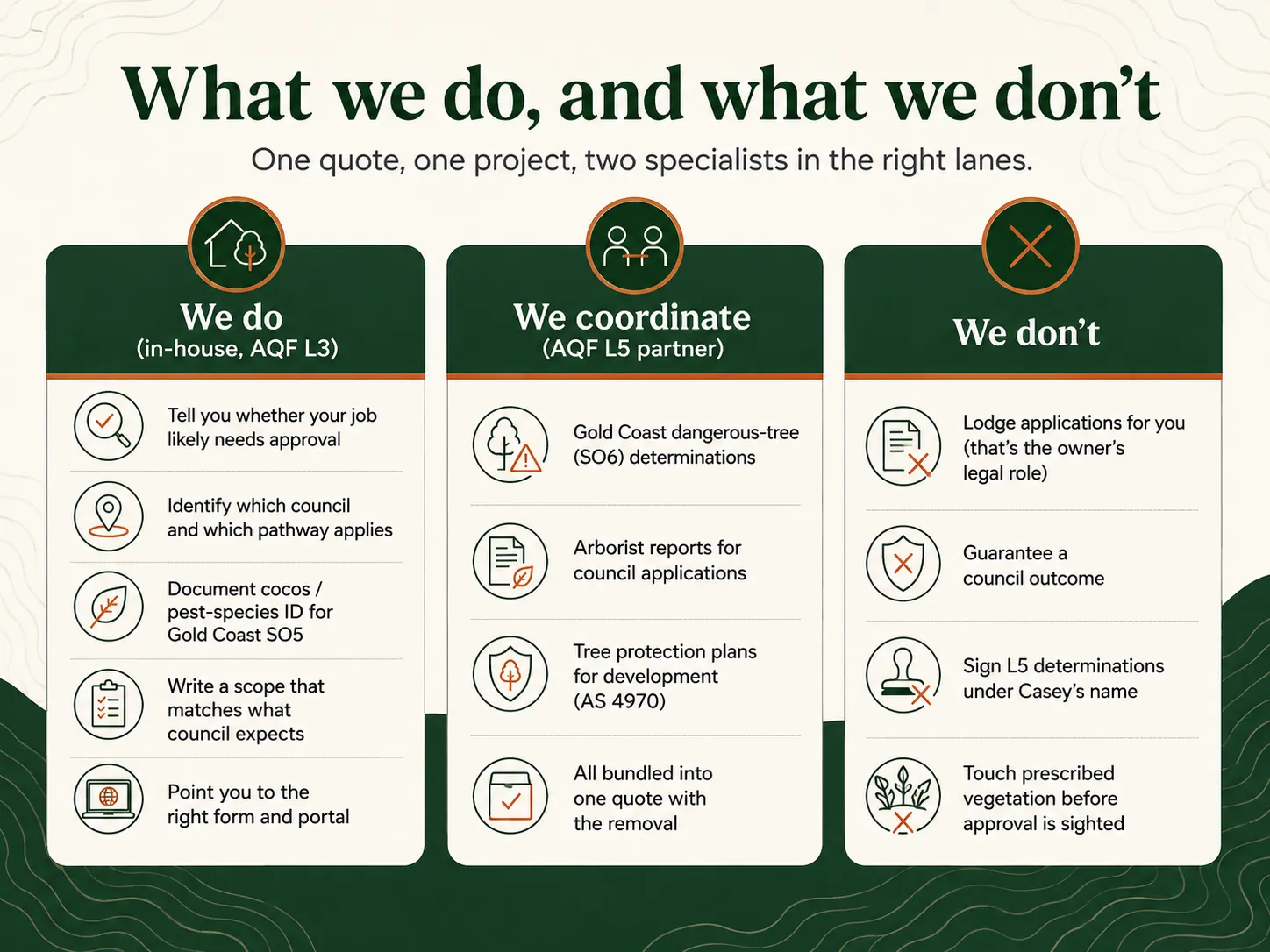
We do (in-house, AQF L3)
- Tell you whether your job likely needs approval
- Identify which council and which pathway applies
- Document cocos / pest-species ID for Gold Coast SO5
- Write a scope that matches what council expects
- Point you to the right form and portal
We coordinate (AQF L5 partner)
- Gold Coast dangerous-tree (SO6) determinations
- Arborist reports for council applications
- Tree protection plans for development (AS 4970)
- All bundled into one quote with the removal
We don't
- Lodge applications for you (that's the owner's legal role)
- Guarantee a council outcome
- Sign L5 determinations under Casey's name
- Touch prescribed vegetation before approval is sighted
Straight answers
Council questions we get asked
Do I actually need council approval to remove a tree?
It depends on the tree and which council you're under. On the Gold Coast, vegetation over 4 metres tall, or with a trunk over 40cm around at 1.4 metres, is generally assessable unless a self-assessable exemption applies. In Tweed Shire, protected (prescribed) vegetation includes local native trees over 5 metres, very large trees (0.8m trunk diameter), koala feed trees and threatened species. Use our self-assessment tool for a quick read, then we confirm on site.
Do you lodge the council application for me?
No, and that's deliberate. The property owner is the legal applicant, so you lodge it. What we do is tell you whether you need approval, identify which pathway applies, write a scope of work that matches what council expects, and point you to the right form and portal. That keeps the legal responsibility where it belongs and makes your application as clean and fast as possible.
Tweed Shire charges no fee to apply. The Gold Coast charges from around $160. We can also coordinate an arborist report through our AQF Level 5 partner when one's needed.
What about a dangerous tree, can it just come down?
The pathway is different on each side of the border. On the Gold Coast, a Council-authorised AQF Level 5 arborist can sign an SO6 determination that a tree is dangerous, and then it can come down without a full application. We coordinate our L5 partner for that and do the removal, so it's one quote and one process.
In Tweed Shire you still lodge an application for a dangerous tree (it's free), but council won't refuse it if it's backed by an arborist's report. We sort the report and the removal together.
My neighbour's tree is dropping branches, what can I do?
Talk to your neighbour first. Nine times out of ten they don't know there's a problem. In NSW you can trim branches overhanging your boundary back to the property line, but you can't go onto their land or damage the tree's health, and the offcuts are technically theirs. Queensland has a similar process under its own neighbour-tree laws.
If it's a genuine hazard or they won't cooperate, document it with photos and dates and get an arborist assessment. We do those, and the report carries weight if it goes to the tribunal or council.
Not sure where your tree stands?
Run the tool above, or just call. We'll tell you straight whether you need approval and what council wants to see.
After hours or storm emergency? Same number. Leave a voicemail or send photos by SMS.